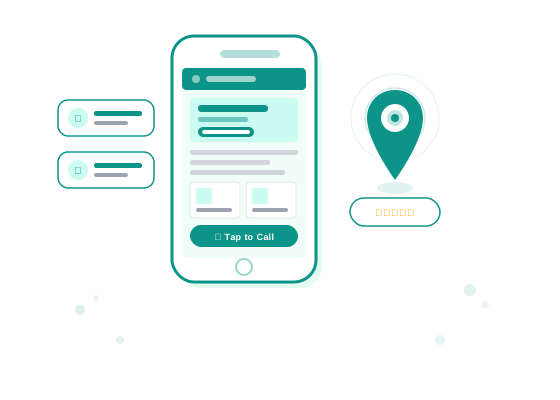
Most people who find your business will see it first on a phone — not a computer. If your website is hard to read, slow, or impossible to tap on a small screen, they leave and call the next business. Biz22 builds every site mobile-first.
Where Your Customers Actually Are
Over 60% of all Google searches now happen on a smartphone. For local searches — "plumber near me," "best nail salon downtown," "pizza open now" — that number is even higher. When someone needs a contractor, a restaurant, or a cleaning service, they pull out their phone, type a few words, and tap the first result that looks trustworthy.
If your website loads slowly, has tiny text, or buttons that are impossible to tap with a thumb, that person is gone in three seconds. They do not pinch-zoom. They do not try to find the phone number hidden in a desktop navigation menu. They scroll down and tap your competitor.
What a Bad Mobile Experience Looks Like
You have seen this before — you land on a website on your phone and something feels immediately off. The text is microscopic. The menu is a horizontal row of seven links that require a magnifying glass to read. The phone number is an image, not a real link, so you can't just tap to call. There is a popup covering half the screen asking you to subscribe to a newsletter.
These are not just annoyances. Each one is a lost customer. Studies show that 57% of users say they will not recommend a business with a poorly designed mobile site. If your competition has a clean, fast mobile experience and you do not, you are handing them customers every single day.
What "Mobile-First" Really Means
"Mobile-first" means the website is designed and built for a small phone screen first, then adapted for larger screens — not the other way around. A mobile-first site has large tap targets so fingers can hit buttons without frustration. Text is readable without zooming. Images scale correctly. The phone number is a real clickable link. The most important information — who you are, what you do, how to contact you — is visible immediately without scrolling.
A responsive design takes this further: the layout automatically adjusts to fit any screen size. One set of content, one website, works beautifully on a 6-inch phone, a 10-inch tablet, and a 27-inch desktop monitor. No separate "mobile version" to maintain, no content getting cut off on certain devices.
Mobile-Friendly Helps You Show Up on Google, Too
Google uses what it calls "mobile-first indexing." That means Google crawls and ranks your site based on how it looks on a mobile device — not your desktop version. If your mobile site is slow, broken, or hard to navigate, Google ranks you lower. A faster, cleaner mobile site = better position in search results = more people finding you.
Page speed matters too. Google measures how long it takes your site to load on a mobile connection. A site that takes more than three seconds to load loses roughly half its visitors before they even see the page. Optimized images, minimal code bloat, and fast hosting are not optional extras — they directly affect whether customers can find you.
DIY Builders vs. Done-for-You
Not all "mobile-friendly" options deliver the same result. Here is how your main choices compare:
| Option | Mobile Result | Your Effort |
|---|---|---|
| Biz22 | Built mobile-first by professionals — fast, clean, tap-to-call included | You answer a few questions. Done. |
| DIY builder (Wix, Squarespace) | Responsive templates, but you must customize correctly or it breaks on mobile | 10–20 hours minimum. Easy to get wrong. |
| Cheap freelancer | Depends entirely on the individual — quality varies widely | Multiple back-and-forth revisions, weeks of waiting |
| Social media only (Facebook/Instagram) | Mobile-native, but not a real website — no Google ranking, no domain, no SEO | Ongoing content creation required |
QHow do I know if my current website is mobile-friendly?
Open your website on your own phone. Try tapping the phone number — does it dial? Try reading the text without zooming. Try tapping the menu. If anything is frustrating, your customers are experiencing the same thing. You can also run Google's free Mobile-Friendly Test by searching that phrase — it gives you a pass/fail score in seconds.
QDo I need a separate mobile website?
No — and you should not build one. A separate mobile site was a workaround from ten years ago. Modern responsive design means one website that works on every screen size automatically. Maintaining two separate sites doubles the work and often creates inconsistencies that confuse customers and hurt SEO.
QWhat is the most important thing on a mobile website for a small business?
A tap-to-call phone number, visible without scrolling. That is it. Everything else matters, but if a customer on a phone cannot tap your number and call you in under three seconds, you have a problem. After that: your business name, what you do, and your location.
QMy business has been around for years without a website. Do I really need one?
If you have survived on word-of-mouth, that is great — but every year more customers search online before they even ask a friend. A mobile-friendly website is your 24/7 business card. It builds trust, shows up in local search, and lets customers find your phone number at 11pm when they need an emergency plumber or a late-night reservation.
Get a Mobile-First Website Built for You
Every Biz22 site is built mobile-first, responsive, and ready to convert phone visitors into paying customers.